Your website is ranking number one and your traffic is still falling. Here's why.
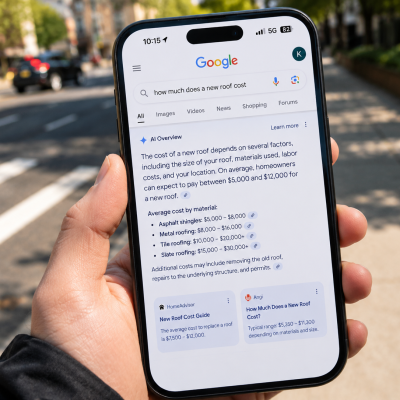
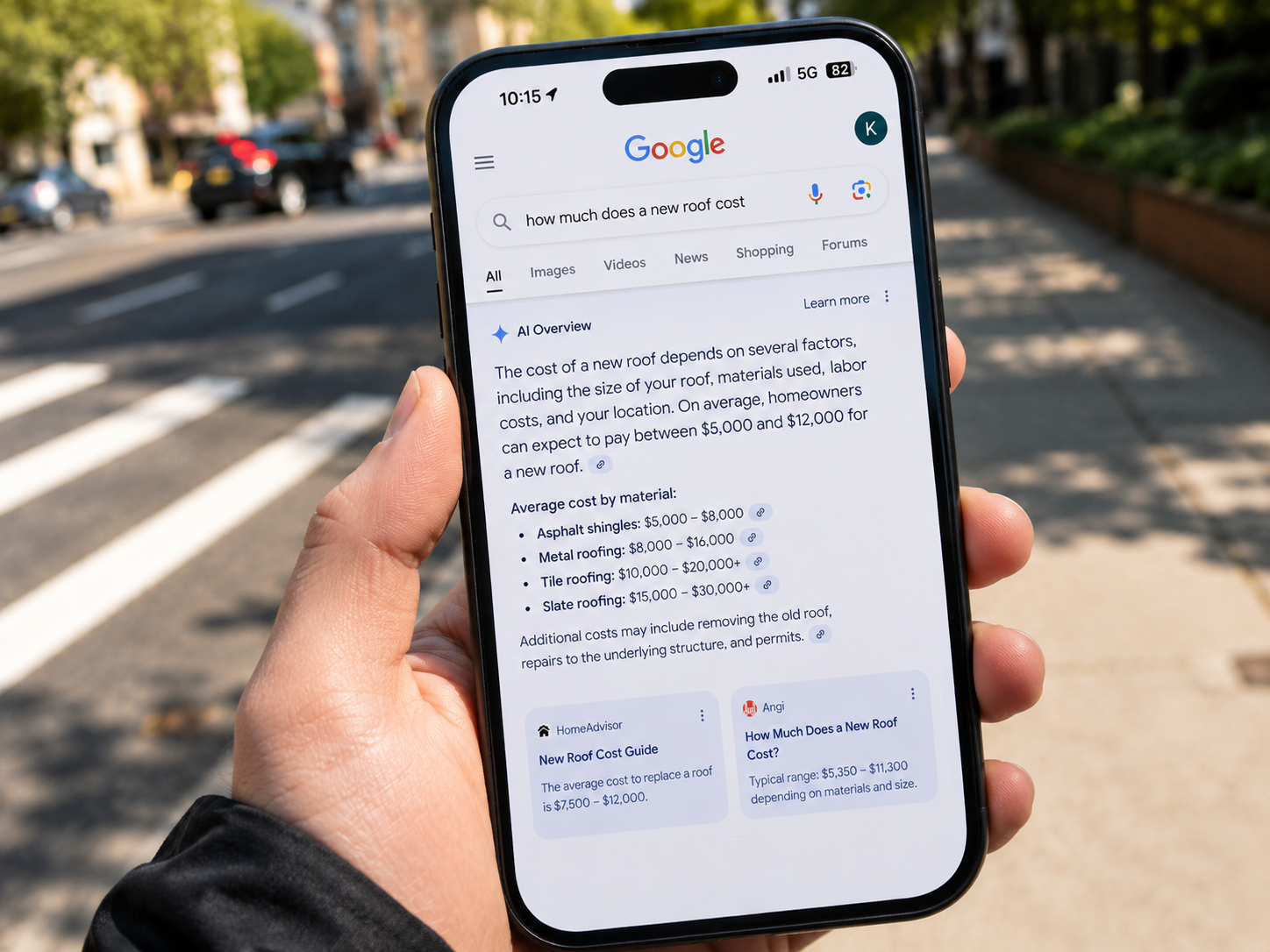
If your organic traffic has dipped over the past year despite your rankings holding steady, you’re not imagining it and you’re not doing anything obviously wrong. Google’s AI Overviews — the AI-generated summaries that now appear above the traditional blue links for a huge share of searches — are answering people’s questions directly on the results page. No click required.
Google itself has said AI Overviews now appear on billions of searches each month. Multiple industry studies through 2026 have found that pages ranking in position one are losing a meaningful chunk of their click-through rate when an AI Overview sits above them, because the searcher already has an answer before they scroll. And it’s not just Google. More people are asking ChatGPT, Perplexity and Gemini questions they’d previously have typed into a search bar — “best accountant in Birmingham” or “how much does a kitchen extension cost” — and getting an answer with a handful of citations, or none at all.
This isn’t a reason to panic, and it isn’t a reason to abandon SEO. It’s a reason to widen what “SEO” means. Ranking well is still the foundation — AI systems still draw heavily on well-ranked, well-structured content — but ranking well is no longer enough on its own if the AI summary is answering the question before anyone reaches your site. The businesses that come out ahead here are the ones that adjust what they optimise for and how they measure success. Here’s where to start.
1. Write the direct answer first, then explain it
AI Overviews and chatbots tend to pull from content that answers a question plainly, near the top of the page, before the supporting detail. If your blog post spends three paragraphs building context before it actually answers “how much does X cost” or “what’s the best way to do Y”, you’re making it harder for an AI system to lift a clean answer — and harder for a human reader in a hurry, too.
Structure your key pages so the direct answer appears in the first sentence or two under each heading, then follow with the detail, examples and nuance underneath. FAQ-style sections work well for this, and marking them up with FAQ schema (more on that below) gives AI crawlers an even clearer signal about what’s being asked and answered.
2. Put real expertise and evidence on the page, not just information
AI models are trained to prefer sources that show genuine first-hand knowledge: original data, case studies, named experts, specific numbers, photos of actual work rather than stock images. Generic, competently written content that just restates what’s already on the top ten results doesn’t give an AI system — or a human reader — any reason to cite you over the next agency saying much the same thing.
If you’ve done a project, quote the actual figures. If you have an opinion based on years of doing this work, say what it is and why, rather than hedging with “it depends on many factors.” This is the same E-E-A-T thinking Google has pushed for years, but it now matters even more, because it’s exactly the kind of content large language models weight most heavily when deciding who to cite.
3. Build your presence beyond your own website
Here’s the part that catches most businesses out: AI systems don’t only look at your site. They cross-reference what’s said about you across review platforms, forums like Reddit, industry directories, local press and other publications. A business with strong reviews on Google and Trustpilot, a few mentions in trade press, and a presence in relevant community discussions is far more likely to get cited than one that only exists on its own domain, however good that domain is.
This is where digital PR, active review management and a bit of genuine participation in relevant online communities pay off in a way they didn’t as directly a few years ago. Getting a mention in a local news piece or a well-regarded industry roundup isn’t just a backlink any more — it’s a signal to AI systems that other sources vouch for you.
4. Use structured data to make your content machine-readable
Schema markup — the structured data added to your site’s code — helps search engines and AI systems understand exactly what a page is about: is this a product, a service, an FAQ, a review, a local business listing. It doesn’t guarantee a citation, but it removes ambiguity, and AI systems consistently favour content they can parse with confidence over content they have to interpret.
At minimum, most businesses should have Organization, LocalBusiness (if you serve a local area), FAQPage and Review schema properly implemented. If you’re not sure whether yours is set up correctly, Google’s Rich Results Test is a quick way to check, and it’s a task worth getting an SEO specialist to audit properly rather than guessing.
5. Track visibility differently, not just traffic
If you’re only measuring success by sessions in Google Analytics, you’ll see a discouraging picture even if you’re doing everything right, because a chunk of the value now shows up as a citation or brand mention rather than a click. Start tracking how often your brand appears in AI answers for the searches that matter to you — there are now tools built specifically for monitoring AI citations, and it’s worth checking manually every so often by asking ChatGPT or Google’s AI Overview the questions your customers would ask.
It’s also worth paying closer attention to the traffic you do still get from search. Visitors who click through despite an AI summary being available tend to be further along and more likely to enquire or buy, because the AI has already filtered out the people who only needed a quick answer. A smaller number of higher-intent visitors can be a perfectly good trade, provided you’re tracking conversions rather than just raw numbers.
What this looks like in practice
We manage SEO for airtravelclaim.com, a flight delay compensation service, and its numbers over the past six months are a useful illustration of the point above: organic search hasn’t dried up, it’s just rewarding a narrower, more deliberate kind of visibility.
Search Console shows total clicks holding at roughly 650 to 950 a month through the spring and summer, with impressions falling from around 174,000 in March to a low of 87,000 in July before recovering slightly in August. That impression drop lines up with what you’d expect if AI Overviews and shifting search behaviour are absorbing some of the vaguer, lower-intent queries the site used to show up for. But clicks didn’t fall anywhere near as much as impressions did, and average position over the period was a respectable 14.9 — the traffic that remained was more concentrated on searches where the site could actually compete and convert.
Google Analytics tells a similarly encouraging story from a different angle. Organic search sessions dipped slightly from 797 in March to 729 in May, then climbed steadily to 928 in June, 1,125 in July and 1,568 in August — more than double the May figure in three months. And when we compared how well different channels convert, organic search sessions turned into a key event (an enquiry or a completed claim) 27.6% of the time over the six months, against 15.2% for paid search. Organic traffic was a smaller slice of the total than paid, but it converted at nearly double the rate.
None of that happened by accident. It’s the direct result of the site being restructured around clear, specific answers to the exact questions claimants search for, rather than generic content about air passenger rights.
The businesses that adapt now will be ahead by next year
None of this means SEO is dead, whatever the more dramatic headlines suggest. It means the goalposts have moved from “rank first” to “be the source AI systems and searchers both trust.” That’s a higher bar, but it’s also one that rewards the businesses willing to do the work properly — clear answers, genuine expertise, a real presence across the web, and technical foundations that make content easy to understand.
If you’re not sure where your business currently stands with any of this, or you’d like a straightforward audit of how visible you are in AI search results as well as traditional rankings, get in touch with ClickFuel — it’s exactly the kind of thing our SEO team looks at every day.